The Dialogue of Saint Simona with a Dick
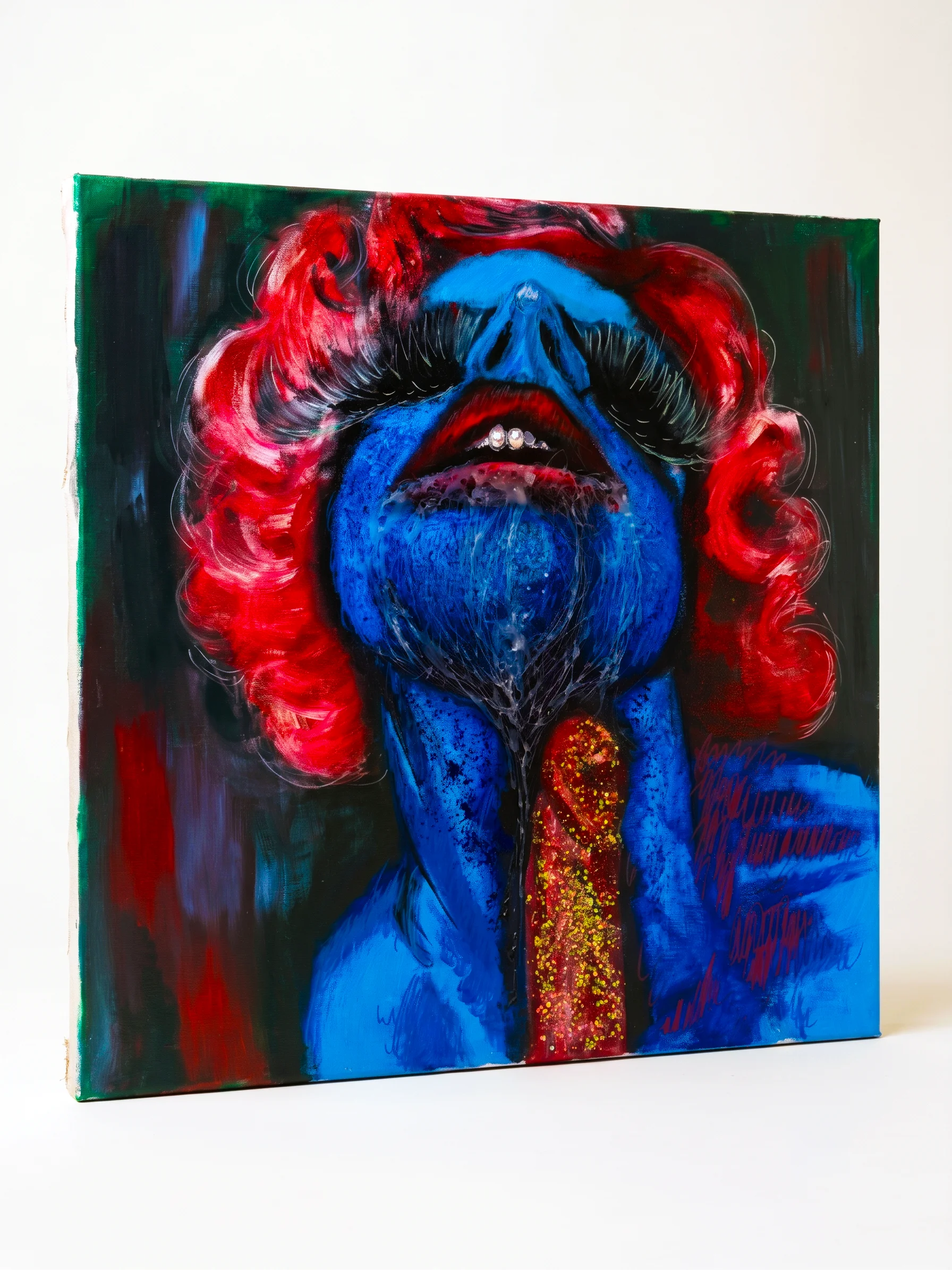
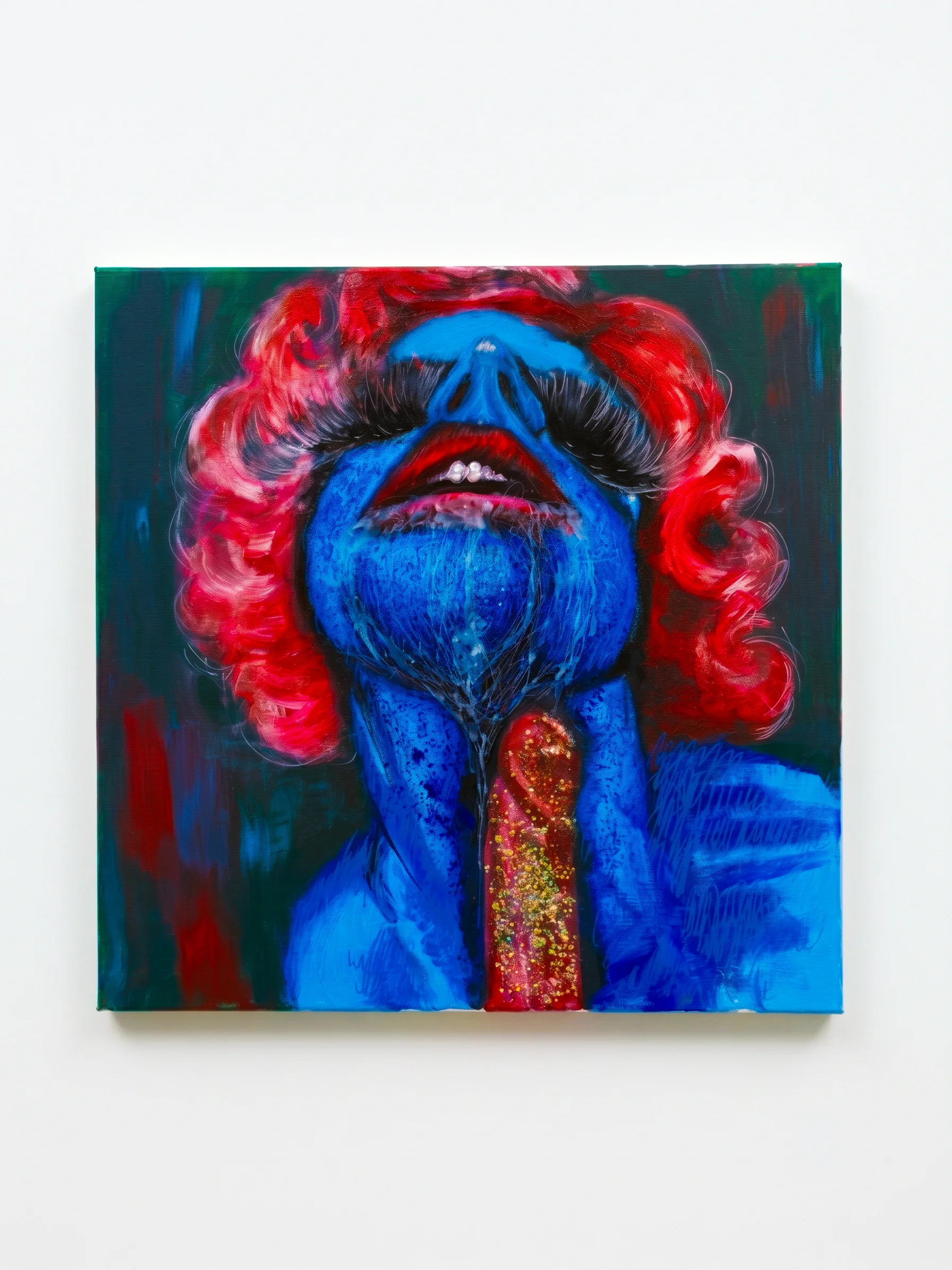
A blue figure assumes the pose of sacred ecstasy as a glittering phallic form rises along the axis of her body, suspending the image between devotion, desire, exposure, and restraint.
Curatorial Summary
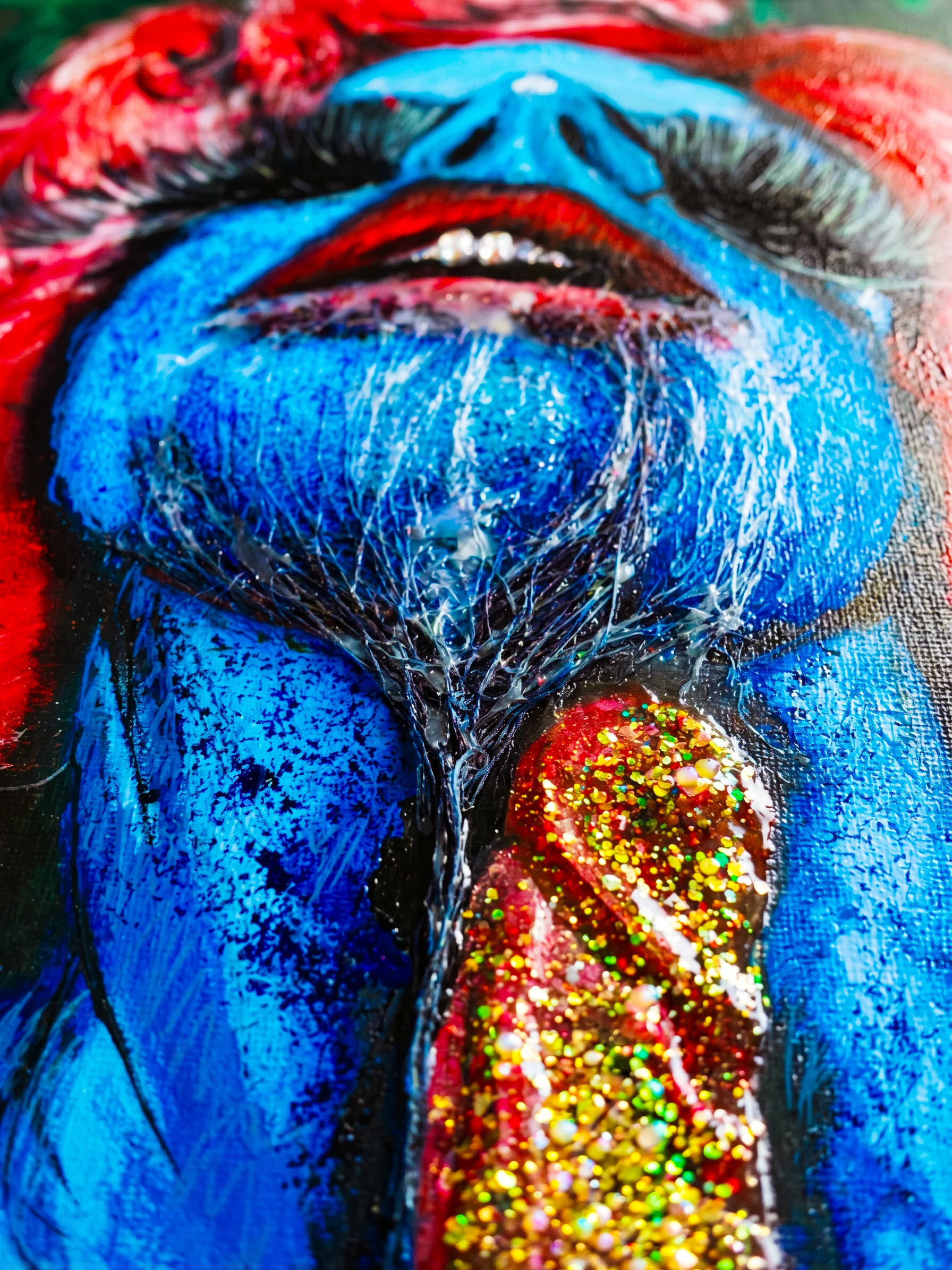
Framed by red curls that form an irregular halo, the central figure tilts her head back and exposes her face while heavy lashes close off any reciprocal gaze. Electric blue skin, glossy lips, and saturated colour translate the visual language of Catholic ecstasy into an exaggerated, theatrical register. A glitter-covered phallic form rises from the lower edge of the canvas, extending the vertical line of the body toward the throat and organizing the entire composition. Its ornamentation makes it seductive, artificial, and faintly absurd, while reinforcing its visual centrality. Drawing on “The Dialogue of Master Polikarp with Death,” where an abstract authority assumes a grotesque bodily form, “The Dialogue of Saint Simona with a Dick” stages an encounter whose meaning remains unsettled: the gesture may suggest rapture, desire, submission, or an attempt to establish a boundary, without allowing any one of these readings to prevail.
artist
statement
I draw on Christian iconography as a visual system that has long regulated bodies, desire, shame, and confession. I borrow its poses, halos, and upward-directed gazes, then redirect them toward physical sensation: saliva, metal, nervous tension, leakage, and the pressure of being watched. Alongside this sacred grammar, I activate another learned script—the “dumb blonde,” a fantasy of femininity reduced to softness, availability, and harmlessness. Marilyn appears here as an image repeatedly emptied of intellect, anger, and contradiction so that she can remain desirable without becoming threatening.
The work begins from the moment this promise of safety starts to fracture. Patriarchal power often arrives through seduction: as a compliment, a romance, or an offer of adoration extended in exchange for predictability and obedience. I treat this dynamic as a choreography already stored in the body. Agency emerges through its renegotiation, even as the habits it produced continue to shape posture, desire, and response. The boundary becomes a bodily practice—unstable, repeated, and performed under pressure.
“The Dialogue of Saint Simona with a Dick” draws on the medieval didactic poem “The Dialogue of Master Polikarp with Death,” in which an abstract authority assumes a grotesque, material form and confronts the human body with its fragility. In my work, Death gives way to another figure presented by culture as inevitable: the phallus as the supposed centre of sexuality, power, and meaning. The title deliberately retains the word “dick,” allowing the symbolic authority of the phallus to collide with something bodily, vulgar, erotic, and absurd.
Immersed in saturated blues and electric contrasts, the central figure tilts her head back as her mouth opens toward the entering form. A branching mass extends from this point of contact, resembling a root system, exposed nerves, or a bolt of electricity. It may obstruct speech, materialize it, or mark the place where an imposed symbol and a bodily response become difficult to separate. The figure remains an icon offered to the gaze while behaving as a body engaged in negotiation—with the symbol, with the viewer, and with its own training in obedience.
The glittering phallic form demands attention, yet its ornamentation also makes that demand unstable. It appears intrusive and seductive, authoritative and ridiculous. I approach the phallus as a culturally produced structure rather than an inherent property of anatomy: a sign repeatedly made to stand for power, universality, and sexual order. Within the image, that authority can be measured, decorated, interrupted, and partially constrained, though never fully removed from the meanings that have already shaped the encounter.
The medieval dialogue is therefore reopened as a scene of authorship rather than a lesson with a predetermined conclusion. The body tests how an inherited symbol may enter the image, what it activates, and what remains beyond its control. The work holds this negotiation without resolving it into submission or mastery. Its agency lies in sustaining the encounter long enough for obedience, attraction, fear, and ridicule to become visible within the same gesture.
exhibition dates