
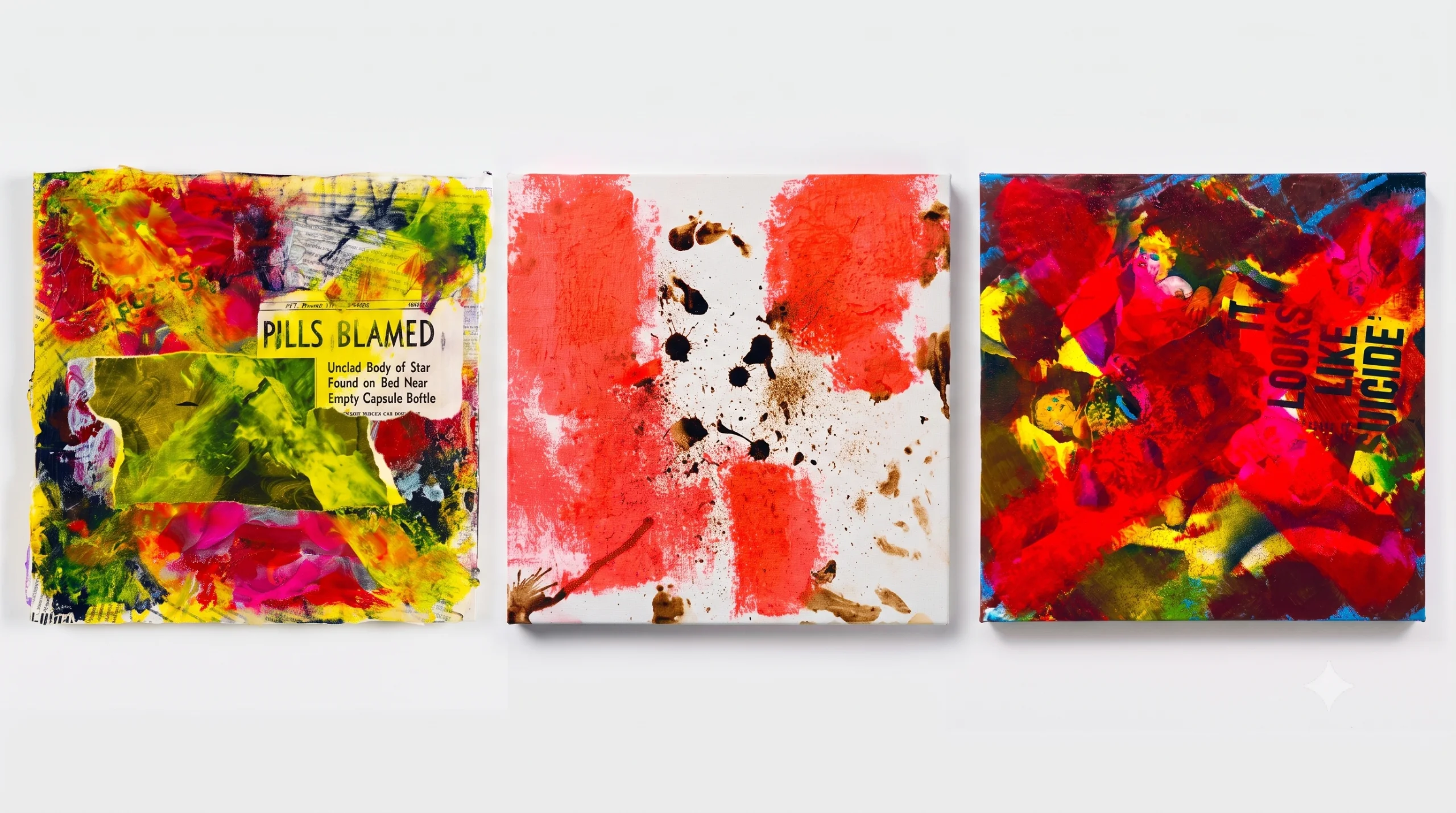


Title-wise: a wrap-up. Fuck, for fuck’s sake. A period of hatred. I could stop there. But since I can’t put down a period without a parenthetical add-on, and I can’t keep biting my tongue any longer — and, above all, I don’t want to — I’ll pour a bit more of my own lived sludge into the social sewer. The sewer is flowing anyway.
First, a quick life report: I’ve been without a job for a year. I survived only thanks to psych meds, a few gigs, my matrons, and loans of over 50k. And besides that — total success: I finally did a solo show with over 30 premiere works and a micro–intervention replica, I did editing and performance in two films, one of which was my total feature-length debut, which I screened in 3 cities, I released a mixtape with an audio collage from the film, I finally showed up at 3 festivals as an artist, I made 2 premiere performances. Oh, I almost forgot — and on top of that I had to become a sole proprietorship, as if I hadn’t been one for years already. Only now it’s entered into the system: I’m a human being in the box labeled “economic entity,” and my stress has a tax ID number.
But back to the sludge and the sewer. I heard from someone who used to be close to me that I’m lazy. Lazy? Meaning what? Meaning it’s not “the system is built to grind you down,” but “you’re defective.” Not “the world can’t keep artists alive,” but “you have no work ethic.” Not “artistic work is permanent readiness with no guarantees,” but “you can’t motivate yourself.” In one word: responsibility dump. Guilt plumbing.
Beyond the rage, Bojana Kunst clicked on for me — The Artist at Work¹. “The artist at work” isn’t just someone who works, but a figure for constant use: always available, ready, flexible. And at the same time that work has the status of “not quite real”: passion, mission, vocation, pleasure — so you can take it, but you don’t have to pay for it like work; you can consume it, but you don’t have to acknowledge the cost.
In this puzzle, “laziness” is the doormat of institutions and NGOs: it’s there to shut down the topic of working conditions. Wipe your feet before you come in. If an artist can’t keep up, it’s “lazy,” not: exhausted, exploited, trapped in a permanent project mode — for a moment, for a grant, for mercy, for “maybe it’ll work out.” One word and case closed: fewer questions, more morality play.
It works like an automatic system: when I say “I’m tired,” I hear “lazy.” When I say “I need rest,” I hear “lack of discipline.” When I say “I don’t have resources,” I hear “bad organization.”
The mechanism is simple: artistic work spills into life and identity, and then gets thrown back at you as insufficient. You’re supposed to be professional without a contract, competent without safety, resilient without rest, creative without the right to weakness. And when you crack — you get a moral diagnosis: lazy.
That’s why this word set me off politically. It only pretends to be private. It carries a code: value is measured by visible effort, rest is suspicious, and if you don’t earn “normally,” your work is a hobby — so your boundaries are a whim.
In that sense, “laz(y/iness)” is wonderfully convenient for everyone around. For former closeness, too. Because if I’m lazy, then she doesn’t have to touch the fact that maybe she left me when I needed support. She doesn’t have to think about the cost of empathy. It’s enough to call me lazy and return to her version of the world: whoever works, has.
I also worked on a performance about sexual violence, about rape. Authorial. Pre-premiere. In Kraków, at Boska Komedia — i.e., where it’s “supposed” to be prestigious². And of course, as with me: everything had to go to shit.
I walk in. I have structure. I have multimedia. I have it all stitched together. And at the moment I’m supposed to start: the computer says no. Refusal. Suddenly I have to improvise. Stitch it live. With my hands in the guts of my own dramaturgy. And sure, something works — but it’s not IT. It’s a prosthesis. It’s “somehow,” and I don’t want a life in “somehow” anymore.
And then it’s over. I gather my stuff. I head to a taxi. That’s when a familiar intellectual falls into my orbit — smile, delight, those eyes that see meaning before they see a person. She says it was incredible. Powerful. Moving. Wow.
And I say: thanks, but for me it was a failure. Nothing worked. Nothing went the way it was supposed to.
And she goes: that failure is queer. That it makes it even more queer³.
I gave Smile Number Four — the one that means “received,” so the situation will stop happening. I got into the taxi. Only then did I start getting pissed off.
Because listen: we can theorize until the end of the world. Failure as resistance, as refusal of the success norm — sure. It’s just that I already have, in me, a refusal to let my life be an endless exercise in failure.
What hurts most is that “queer” sometimes becomes just a new version of accepting the place we’ve been assigned. As if the system were saying: you won’t get stability or backup, but we’ll give you theory so you can name it and swallow it. Congrats, you have language. Now swallow the thorn elegantly.
“Queer failure” is beautiful only when it’s a choice. When it’s a gesture of refusal. But when I’m standing after a performance about rape and I say, “it was a failure because my equipment fucked up,” telling me it’s great because it’s queer sounds like: get used to it.
No. That’s not liberating. That’s exhausting.
Because I don’t want to be a concept that justifies someone else’s comfort. I want what I do to have the right to succeed. Without the romantic “a breakdown is art too.” No. A breakdown is a breakdown. And I have the right to be furious that, again, I had to live through something in emergency mode.
And please: don’t tell me again that it was “beautiful” — the way every functional and life failure of mine becomes beautiful, the one I work on so I don’t go completely insane. Beautiful will be when the system finally stops eating my life and calling it a queer aesthetic.
Stop confusing exhaustion with laziness.
Stop confusing depression with lack of ethics.
Stop confusing lack of infrastructure with lack of character.
Stop turning my attempt to survive into evidence of guilt.
And as a punchline I’ll quote the line that opens and closes my film: Everything is falling apart, let’s fuck while we can. For money, paying money, or mutually holding that money in countless amounts. That’s what I wish for those who wish it for themselves.
Footnotes
1. Bojana Kunst, The Artist at Work: Proximity of Art and Capitalism (Polish edition: Artysta w pracy. O pokrewieństwach sztuki i kapitalizmu).
2. Boska Komedia International Theatre Festival (Kraków).
3. For a theoretical context of “queer failure”: Jack Halberstam, The Queer Art of Failure, Duke University Press, 2011.